
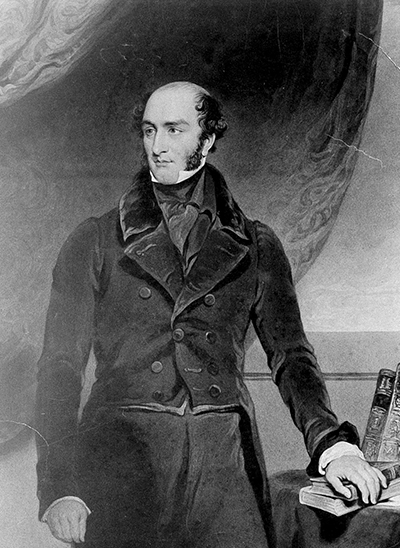
“Time Me, Gentlemen, Time Me”
The Fastest Surgeon of the 19th Century
Dr. Robert Liston was known both for his showmanship and his effectiveness. Before anesthesia, speed was essential to minimizing pain and improving odds of survival. Imagine lying on a table in an old-school operating room. Faces stare down at you from the viewing galleries above, and your leg throbs with pain from a broken bone – infection is just starting to set in. The door opens and three men in blood-stiffened aprons walk in, carting a collection of knives and saws. Two of them grab your shoulders and arms and pin you to the table. The third picks out one of the knives from the cart.
“Time me, gentlemen,” he calls out to the gathered spectators. “Time me.”
The man grabs your leg and begins to cut just below the knee. He continues to hold onto your leg as one of his lackeys gets a tourniquet around it. To free his cutting hand, he clasps the bloody knife in his teeth and picks up a saw. He cuts back and forth through the bone, drops the severed leg into a bucket lled with sawdust, and sews you up, to the applause of the men sitting in the wings. As promised they’ve timed the whole procedure — from rst incision to clipping the loose threads on the sutures — at just two and a half minutes.
In his most famous mishap, he was moving so fast that he took off a surgical assistant’s ngers as he cut through a leg.
The man who just ew through your amputation with apparent reckless abandon was Dr Robert Liston, one of the nest surgeons of the time.
Dr Richard Gordon, a surgeon and medical historian, calls Liston the “fastest knife in the West End.” His style may have seemed careless, but in the age before anaesthesia, speed was essential to minimizing the patient’s pain and improving their odds of surviving surgery.
Slower surgeons sometimes had pain-wracked and panicked patients wrestle free from their assistants and ee from the operating room. Only about one of every 10 of Liston’s patients died on his operating table at London’s University College Hospital. The surgeons at nearby St. Bartholomew’s, meanwhile, lost about one in every four.
Liston’s quick hands were so sought after, patients sometimes had to camp out in his waiting room for days, waiting for their turn to see him. Liston tried to see every last one of these patients, no matter their condition. He especially loved treating those cases that his fellow surgeons had dismissed as beyond help, which earned him a reputation among colleagues, as being showy.
Occasionally, Liston’s speed and showmanship actually were a hindrance to his operations. Once, he took a patient’s testicles off along with the leg that was being amputated. His most famous (and possibly apocryphal) mishap was the operation where he was moving so fast that he took off
a surgical assistant’s ngers as he cut through a leg and, while switching instruments, slashed a spectator’s coat. The patient and the assistant both died from infections of their wounds, and the spectator was so scared that he’d been stabbed that he died of shock. The asco is said to be the only known surgery in history with a 300 percent mortality rate.
Liston had more going for him than just a quick and (mostly) steady slice, though. He was a highly-regarded surgical instructor and prolic inventor. Some of his creations, like the “Liston splint” and “bulldog” locking forceps, are still around today.
Towards the end of his career, Liston made medical history and performed a surgery that made his nimble hands obsolete in Britain. From that point on, pain would no longer be a hurdle to successful surgery, and speed wouldn’t be the surgeon’s greatest asset.
In 1846, Liston received a patient named Frederick Churchill, whose right knee had been causing him terrible problems for years. None of the treatments he’d been given before had worked, and now the only option was amputation. The day of the surgery, Liston walked into the operating
room and, instead of grabbing a knife and asking his audience to time him, he pulled out a jar. Ether, American dentists and doctors had recently demonstrated, could be used as a surgical anaesthetic. “We are going to try a Yankee dodge today, gentlemen,” Liston told the crowd, “for making men insensible.”
Liston’s colleague, Dr William Squire, administered the anaesthesia. He held a rubber tube to Churchill’s mouth so he could inhale the ether, and after a few minutes, he was out. Squire placed a handkerchief laced with more of the stuff over Churchill’s face to keep him that way, and then Liston began the operation.
A mere 25 seconds later, the amputation was complete. Churchill roused a few minutes later and reportedly asked when the operation was going to begin, to the amusement of the audience.
Liston died in a sailing accident, still the fastest knife London had ever known.