
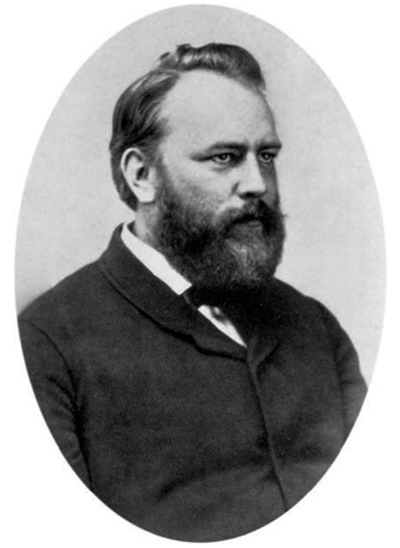
Theodor Billroth was a Prussian-born Austrian surgeon and amateur musician.
Surgery
As a surgeon, he is generally regarded as the founding father of modern abdominal surgery.
As a musician, he was a close friend and condant of Johannes Brahms.
Torn between a career as a musician or as a physician, he acceded to his mother’s wishes and enrolled himself to study medicine.
An early adopter of the “white coat ” Billroth was directly responsible for a number of landmarks in surgery, including the rst esophagectomy (1871), the rst laryngectomy (1873), and most famously, the rst successful gastrectomy (1881) for gastric cancer, after many ill-fated attempts. Legend has it that Billroth was nearly stoned to death in the streets of Vienna when his rst gastrectomy patient died after the procedure. He was the rst surgeon to excise a rectal cancer and by 1876, he had performed 33 such operations.
Music
Billroth was a talented amateur pianist and violinist. He met Brahms in the 1860s, when the composer was a rising star of the Viennese musical scene. They became close friends and shared musical insights. Brahms frequently sent Billroth his original manuscripts in order to get his opinion before publication, and Billroth participated as a musician in trial rehearsals of many of Brahms’ chamber works before their rst performances. Brahms dedicated his rst two string quartets, Opus 51, to Billroth. Billroth started an essay called “Wer ist musikalisch?” (“Who is musical?”) which was published posthumously by Hanslick. It was one of the earliest attempts to apply scientic methods to musicality. In the essay, Billroth identies different types of a musicality (tone deafness, rhythm-deafness and harmony-deafness) that suggest some of the different cognitive skills involved in the perception of music. Billroth died in Opatija, Austria-Hungary, before he could complete the research.
Excelling at both his vocation and his avocation, Billroth never saw science and music as being in conict. On the contrary, he considered
the two to complement each other. “It is one of the supercialities of our time to see in science and in art two opposites,” he wrote in a letter. “Imagination is the mother of both.”