
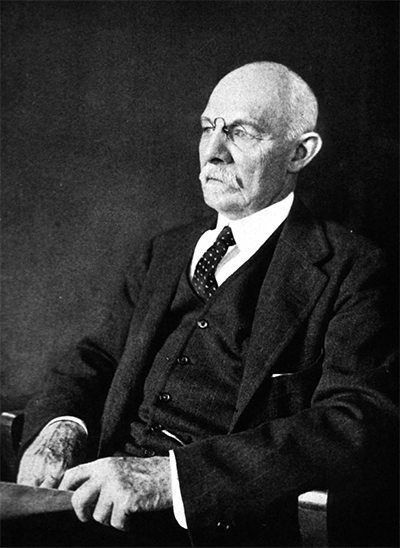
William Stewart Halsted was an American surgeon who emphasized strict aseptic technique during surgical procedures, was an early champion of newly discovered anesthetics and introduced several new operations, including the radical mastectomy for breast cancer.
Along with William Osler, (Professor of Medicine), Howard Atwood Kelly, (Professor of Gynecology), William H Welch, (Professor of Pathology)
Halsted was one of the “Big Four” founding professors at the Johns Hopkins Hospital.
Throughout his professional life, he was addicted to cocaine and later also to morphine, which were not illegal during his time. The addictions were a direct result of Halsted’s use of himself as an experimental subject, in investigations on the effects of cocaine as an anesthetic agent.
History of mastectomy – before and after Halsted.
The operation described by Halsted, in 1894 and called radical mastectomy, represents a milestone in the treatment of breast cancer. It consisted of removal of the breast, muscles and axillary lymph nodes. The pre-Halsted era saw attitudes ranging from the wilful abstention to brutal treatments by cauterization or amputation. The introduction of anaesthesia and asepsis enabled more advanced surgical attempts. The stratication of patients into operable and nonoperable categories has improved surgical outcome. After attempts to extend Halsted procedure (by extended or super-radical mastectomies) proved to be of little benet, a minimally-invasive trend emerged gradually. It started with modied radical mastectomy that spares the muscles and was then followed by breast conservative surgery that leaves breast tissue behind.